Choosing the best enterprise cloud hosting providers is one of the most important decisions for any business moving into 2026. The right cloud platform can boost performance, security, scalability, and cost efficiency. This guide breaks down the leading enterprise cloud hosting options and compares what each one offers.
What Makes an Enterprise Cloud Hosting Provider the Best?
Key Factors Enterprise Companies Must Consider
-
High uptime guarantees (99.99%+)
-
Global data centers
-
Advanced security and compliance tools
-
Scalability for rapid growth
-
Flexible pricing models
-
Integrated AI, analytics, and automation
-
Reliable customer support
Why Cloud Hosting Matters for Large Businesses
Enterprise workloads are growing more complex. Applications, databases, and distributed teams require powerful cloud infrastructure that delivers performance without compromising security.
Top 10 Best Enterprise Cloud Hosting Providers in 2026
Below is an in-depth analysis of the leading enterprise cloud platforms you should consider.
1. Amazon Web Services (AWS)
Why AWS Leads the Enterprise Cloud Market
AWS remains the most powerful and widely used cloud platform, offering unparalleled scalability and a vast range of enterprise tools.
Key Features
-
200+ cloud services
-
AI/ML tools like SageMaker
-
Global CDN with CloudFront
-
Strong focus on compliance (HIPAA, ISO, SOC)
-
Best for enterprises managing large distributed workloads
Pros
-
Very flexible
-
Extremely secure
-
Massive ecosystem
Cons
-
Complex for beginners
-
Pricing can increase quickly
2. Microsoft Azure
Perfect for Businesses Using Microsoft Ecosystem
Azure integrates seamlessly with Windows Server, Microsoft 365, Active Directory, and enterprise security solutions.
Key Features
-
Hybrid cloud support
-
Enterprise-grade security
-
Automated scaling
-
Ideal for corporations with on-premise + cloud environments
Pros
-
Strong hybrid capabilities
-
Excellent for enterprise IT teams
Cons
-
More technical expertise required compared to smaller cloud hosts
3. Google Cloud Platform (GCP)
Leading in AI, Big Data, and Analytics
GCP is the best choice for enterprises that rely heavily on machine learning and large-scale data processing.
Key Features
-
Vertex AI platform
-
Carbon-neutral cloud hosting
-
Global fiber network
-
Competitive pricing
Pros
-
Superior AI tools
-
Lower cost than AWS/Azure
Cons
-
Smaller market share
-
Not as many enterprise-ready integrations as AWS
4. IBM Cloud
Best for Enterprises Requiring High-Level Security
IBM Cloud combines virtual servers, bare-metal servers, and advanced encryption technologies for mission-critical workloads.
Key Features
-
Quantum-safe encryption
-
Advanced hybrid cloud models
-
Strong compliance focus
Pros
-
Excellent security
-
Built for enterprise-level data
Cons
-
Limited compared to AWS/Azure in general cloud services
5. Oracle Cloud Infrastructure (OCI)
Ideal for Large Databases and ERP Systems
Oracle Cloud is optimized for companies using Oracle Database, Oracle ERP, or high-performance compute workloads.
Key Features
-
Extremely fast bare-metal servers
-
Autonomous database technology
-
Competitive pricing for enterprises
Pros
-
Strong for database-heavy workflows
-
Excellent performance
Cons
-
Niche-focused; not ideal for general web hosting
6. Alibaba Cloud
Strongest Option for Asian and Global Markets
Alibaba Cloud powers some of the world’s largest eCommerce and enterprise operations.
Key Features
-
Global DDoS protection
-
Big data processing
-
Affordable enterprise pricing
7. DigitalOcean (For Mid-Size Enterprise Teams)
Simplicity + Power for Growing Companies
While not as advanced as AWS, DigitalOcean is easier to manage and great for development teams.
8. Linode (Akamai Cloud)
Affordable Enterprise Cloud Hosting
Great for companies looking for predictable pricing with strong security and reliability.
9. Vultr High-Performance Cloud
Ideal for Developers and Scalable Projects
Vultr offers enterprise-grade SSD servers and global deployment.
10. VMware Cloud
Best for Migrating Legacy Systems to Cloud
VMware allows enterprises to move on-premise workloads into cloud environments easily.
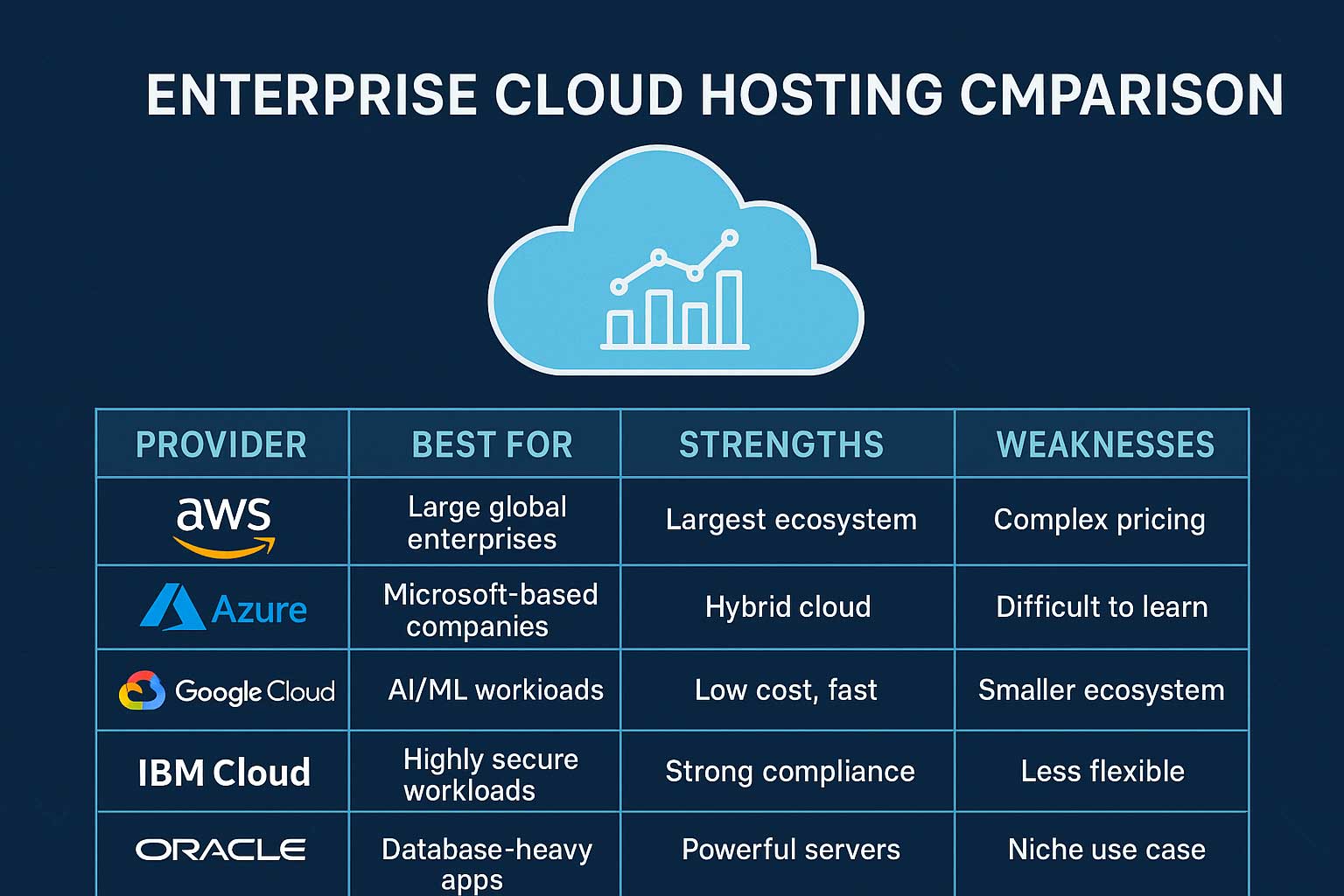
Enterprise Cloud Hosting Comparison (2026)
| Provider | Best For | Strengths | Weaknesses |
|---|---|---|---|
| AWS | Large global enterprises | Largest ecosystem | Complex pricing |
| Azure | Microsoft-based companies | Hybrid cloud | Difficult to learn |
| GCP | AI/ML workloads | Low cost, fast | Smaller ecosystem |
| IBM Cloud | Highly secure workloads | Strong compliance | Less flexible |
| Oracle Cloud | Database-heavy apps | Powerful servers | Niche use case |
How to Choose the Best Enterprise Cloud Hosting Provider
1. Identify Your Business Requirements
-
Traffic volume
-
Storage needs
-
Global coverage
-
AI or big data workflows
2. Consider Security & Compliance
Use this checklist:
-
SOC, ISO, HIPAA support
-
DDoS protection
-
Encryption tools
-
Identity & access management
3. Compare Pricing Models
Consider:
-
On-demand pricing
-
Reserved instances
-
Monthly subscriptions
4. Test Customer Support
Enterprise cloud hosting requires 24/7 support, ideally with:
-
Dedicated success managers
-
Technical engineers
-
Fast response times
Recommended Use Cases for Each Cloud Provider
- Best for Global Operations → AWS
- Best for Microsoft-Environments → Azure
- Best for AI/ML Innovation → Google Cloud
- Best for Enterprise Security → IBM Cloud
- Best for ERP/Databases → Oracle Cloud
Selecting the best enterprise cloud hosting providers is crucial for ensuring performance, security, and long-term scalability. AWS, Azure, and Google Cloud remain the top contenders, but IBM Cloud and Oracle Cloud offer specialized solutions tailored for high-security and database-intensive workloads. Evaluate your business needs carefully to choose the right cloud platform for 2026 and beyond.
Internal Link Suggestions
- How to Create a Google Ads Campaign Step-by-Step (Beginner’s Complete Guide)
- Top 7 Best Business Insurance Providers for Small Businesses in 2026 (Expert Guide)
- Top 10 High-Paying Google AdSense Niches in 2026: The Ultimate Guide for Bloggers
FAQs
1. Which is the best enterprise cloud hosting provider in 2026?
AWS leads overall, but Azure and Google Cloud are strong depending on your ecosystem and workload needs.
2. What features define enterprise-grade cloud hosting?
High uptime, global data centers, advanced security, scalability, and compliance certifications.
3. Is Google Cloud good for large enterprises?
Yes, especially for AI, machine learning, and data-intensive operations.
4. Which cloud hosting is best for security?
IBM Cloud and AWS offer the strongest enterprise security features.
5. How do I choose the right enterprise cloud solution?
Analyze workload type, security needs, budget, integration requirements, and scaling plans.